Contractor Bid Bonds vs. Performance Bonds: What's the Difference and Why GCs Demand Both
You've built your contracting business through experience, strong relationships, and completed projects. Now you want access to larger opportunities.
That is where surety bonds become essential.
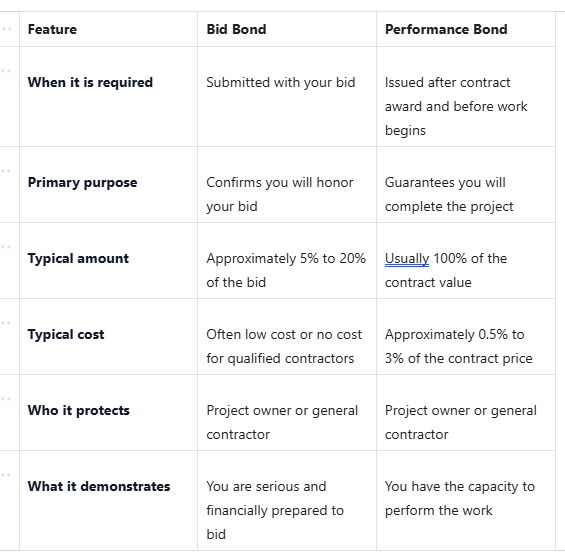
A bid bond helps you compete for a project. A performance bond helps you fulfill the project after you win it. General contractors, project owners, and public agencies often require both because bonds transfer much of the financial risk of contractor default.
So, what is the difference between a contractor bid bond and a performance bond?
The answer becomes clear when you look at when each bond is used, what each bond guarantees, and how each one supports your growth.
The Simple Difference Between Bid Bonds and Performance Bonds
A bid bond protects the project owner during the bidding process.
A performance bond protects the project owner after you win the contract.
The bonds work together. One supports your promise to accept the job. The other supports your promise to complete it.
What Is a Contractor Bid Bond?
A bid bond is submitted with your construction bid. It guarantees that if you win the project, you will:
✔ Sign the contract at your submitted bid price
✔ Provide any required performance and payment bonds
✔ Move forward according to the terms of the solicitation
A bid bond gives the project owner confidence that your proposal is genuine. It prevents contractors from submitting speculative bids and then walking away when they discover the project is more difficult or less profitable than expected.
How Much Does a Bid Bond Cover?
Bid bonds commonly cover 5% to 20% of the bid amount, depending on the project requirements.
For example, if you submit a $500,000 bid and the project requires a 10% bid bond, your bid bond amount would be $50,000.
The bond does not mean you are paying $50,000. It means the surety guarantees up to that amount if you win the bid and then refuse to sign the contract or provide the required final bonds.
For qualified contractors, bid bonds are often low cost or included as part of an established surety program. The bond usually remains active only through the bidding and award stage.
What Happens If You Win but Do Not Accept the Contract?
If you win the bid but refuse to sign the contract, the project owner may suffer financial losses. The owner may need to award the project to the next qualified bidder at a higher price.
A bid bond may respond to the difference between your bid and the next responsible bid, subject to the bond’s terms and limit.
That is why you should never bid casually. Before submitting a bid, confirm that you understand the scope, schedule, labor requirements, material costs, and bonding requirements.
What Is a Performance Bond?
A performance bond is issued after you are awarded the contract. It guarantees that you will complete the project according to the contract terms.
The performance bond supports your obligations related to:
✔ Completing the work
✔ Meeting project specifications
✔ Following the agreed schedule
✔ Satisfying contract conditions
✔ Correcting covered performance issues
A performance bond does not replace your project management responsibilities. It provides the project owner with financial protection if your business defaults and cannot complete the work as promised.
How Much Does a Performance Bond Cover?
A performance bond typically covers 100% of the contract value.
For a $500,000 construction contract, the performance bond may have a $500,000 penal sum. The penal sum is the maximum amount the surety may be responsible for under the bond, subject to the bond language and applicable law.
Performance bond premiums commonly range from 0.5% to 3% of the contract price. Your rate may depend on factors such as:
✔ Your personal and business credit
✔ Financial statements and working capital
✔ Experience with similar projects
✔ Current backlog and workload
✔ Banking relationships
✔ Project size and complexity
✔ Claims history
✔ Your existing bonding capacity
The performance bond costs more than a typical bid bond because the surety is supporting the full contract value and accepting a much longer performance obligation.
The Three Parties in Every Surety Bond
Both bid bonds and performance bonds involve three parties.
1. Principal: You, the Contractor
The principal is the contractor responsible for fulfilling the bonded obligation.
You are responsible for providing accurate information, completing the work, and complying with the contract.
2. Obligee: The Project Owner
The obligee is the project owner or other party requiring the bond.
On some projects, the obligee may be a public agency. On private projects, the obligee may be the owner or general contractor.
3. Surety: The Bond Company
The surety is the bond company that issues the guarantee.
The surety evaluates your financial strength, experience, operational history, and ability to complete the work. If you default, the surety may investigate the claim and pursue available remedies under the bond.
A surety bond is not the same as traditional insurance for your business. With insurance, the carrier generally assumes covered loss risk. With a surety bond, the surety expects you to fulfill your obligations and may seek reimbursement from you for valid claim payments.
That makes your bonding relationship important. Your surety is not simply issuing paperwork. It is evaluating whether your business is ready for the commitment.
Why General Contractors and Owners Demand Both Bonds
A project owner faces serious financial risk when a contractor fails to perform.
A default can lead to:
Delayed completion
Increased labor and material costs
Subcontractor disputes
Financing problems
Lost revenue
Additional administrative expenses
Damage to the owner’s reputation
Bid bonds and performance bonds address different stages of that risk.
The Bid Bond Protects the Award Process
The bid bond helps ensure that the winning contractor will honor the submitted price and proceed with the contract.
Without that guarantee, an owner could waste valuable time evaluating a bid that the contractor never intends to accept.
The Performance Bond Protects the Project
The performance bond gives the owner options if the contractor defaults. Depending on the circumstances and bond terms, the surety may help finance completion, arrange for another contractor, or compensate the owner for covered losses up to the bond limit.
The owner gains confidence. You gain access to opportunities that may otherwise be unavailable.
Public Works, Private Projects, and the Miller Act
Bid and performance bonds are standard requirements on many public works projects. They are also common on larger private construction projects where the owner or general contractor wants additional financial protection.
For federal construction projects, the Miller Act generally requires performance and payment bonds on covered federal contracts exceeding $150,000. Federal solicitations may also require a bid guarantee, often up to 20% of the bid price or $3 million, whichever is less, according to the solicitation and applicable federal acquisition rules.
You can review the federal requirements through the Miller Act provisions in the U.S. Code and Federal Acquisition Regulation Part 28.
State and municipal projects may follow their own requirements under “Little Miller Acts.” Private project requirements vary by contract.
Always review the specific bid documents. Bond percentages, deadlines, forms, and obligee information must match the project requirements.
How Bonding Capacity Helps You Win Bigger Jobs
Your bonding capacity is the maximum amount of work your surety is willing to support.
It may include:
Your maximum single-project bond
Your maximum total bonded backlog
Your ability to provide bid, performance, and payment bonds
Your available working capital for new work
Strong bonding capacity signals that your business is prepared for larger contracts. It can help you compete for better opportunities, satisfy general contractor requirements, and build trust with project owners.
But capacity does not grow automatically.
You can strengthen your position by:
✔ Maintaining accurate, current financial statements
✔ Building reliable banking relationships
✔ Managing job costs closely
✔ Completing projects successfully
✔ Keeping your backlog realistic
✔ Communicating early about potential challenges
✔ Working with a surety professional before you submit a large bid
Your bond application is more than an administrative task. It is part of your growth strategy.
Bid Bond or Performance Bond: Which One Do You Need?
The answer depends on where you are in the project process.
Are you submitting a proposal?
You likely need a bid bond if the solicitation requires one.
Have you been awarded the contract?
You may need a performance bond before signing or beginning work.
Does the project involve public funds?
Review the applicable federal, state, or local bonding requirements.
Is the job privately funded?
Read the contract carefully. Large owners and GCs frequently require performance and payment bonds even when a public law does not.
What if you are unsure?
Start by reviewing the bid package and contacting your surety advisor before the deadline. A last-minute bond request can create unnecessary pressure and may limit your options.
Build Trust. Pursue Better Contracts.
You have already invested years building your contracting business. The right bonding program helps protect that investment and demonstrate your readiness for the next opportunity.
A bid bond shows that you are serious about your proposal. A performance bond shows that you have the support and capacity to complete the work.
Together, they help you build credibility, protect project owners, and compete for larger contracts.
Shady Oak Insurance Agency can help you understand your bonding requirements, prepare your information, and develop a surety program that supports your contract pipeline.
Call 612-361-9717 to get bonded and start building your capacity for the opportunities ahead.
For broader construction protection, review The Contractor’s Insurance Stack: What You Actually Need to Work in 2026 and The Three-Way Handshake: Why Your Business Needs a Surety Bond.
Bond requirements, costs, and claim remedies vary by project, jurisdiction, contract language, and underwriting factors. This article is for general information and is not legal or financial advice.
